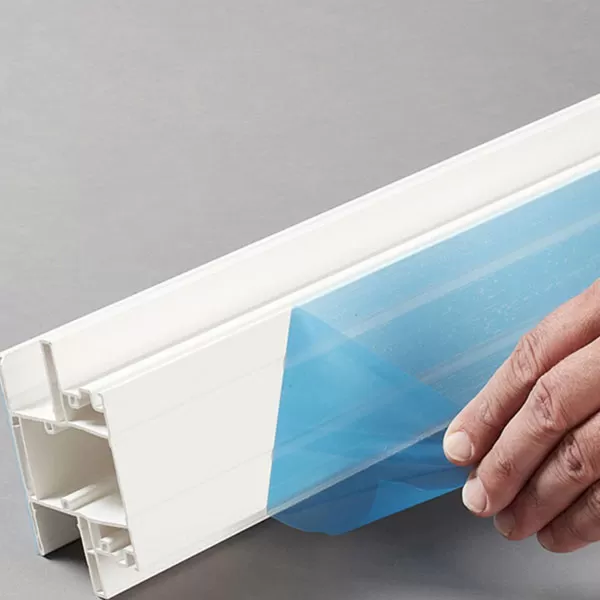
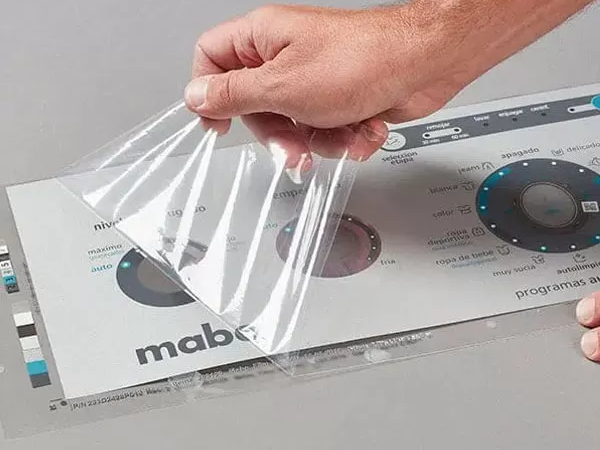
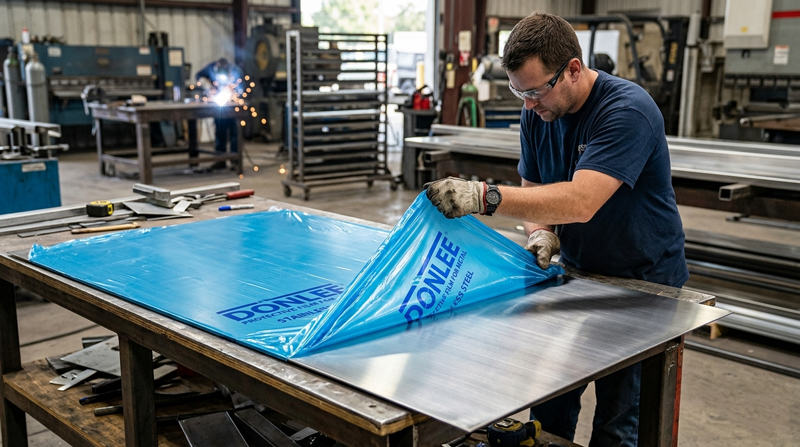
Peeling back a protective film should feel like a win—revealing a flawless, pre-coated surface ready for fabrication, forming, or installation. But when that film leaves behind cloudy “ghosting,” sticky patches, or a visible adhesive haze, it quickly becomes a costly quality problem.
Adhesive transfer isn’t just cosmetic. It can trigger rework (manual cleaning and labor hours), create inconsistencies in downstream processes, risk coating damage from aggressive solvents, and even lead to rejected shipments. At Donlee, we treat clean removal as an engineering outcome—not luck—by focusing on surface chemistry, substrate compatibility, and real-world handling conditions.To learn more about Donlee solutions for pre-finished substrates, visit our protective plastic film for metal product page.
Most protective films use a pressure-sensitive adhesive (PSA) designed to stay bonded during processing, then release cleanly at removal. Adhesive residue happens when that balance shifts—often because the adhesive, backing, substrate, or environment is out of spec.
Clean removal depends heavily on surface energy and how the PSA interacts with a metal’s topcoat. In pre-coated metal protection, common finishes include:
PVDF (often used for architectural panels)
Polyester coil coatings (widely used across fabricated components)
Other specialty paints and topcoats with varying additives and slip properties
If the adhesive is too aggressive for the coating’s chemistry (or the coating has low surface energy), the PSA may shear or “split,” leaving residue behind.
PSAs can increase bond over time (commonly called dwell). If a film remains on too long—especially under heat—peel adhesion strength (often measured in oz/inch) can rise beyond the coating’s ability to release cleanly.
In some cases, solvents or components in paint systems haven’t fully outgassed. That can contribute to chemical interaction with the adhesive layer—especially on newly coated coils—raising the chance of transfer or staining.
UV radiation can degrade standard films and adhesive polymers, weakening cohesive strength and promoting adhesive transfer. This is especially common when:
Coils or sheets are stored outdoors
Skids are staged near dock doors or windows
Finished panels sit on-site before installation
A UV-resistant film (often with UV-stabilized layers) helps prevent this “baking” effect.
Temperature is a major driver of PSA behavior:
Heat can soften adhesives and increase wet-out, raising bond strength
Cold can make adhesives brittle, increasing the risk of adhesive splitting during removal
For consistent results, aim for stable storage conditions—ideally climate-controlled—and avoid leaving protected material in direct sun or unconditioned trailers for extended periods.
Every protective plastic film for metal has a recommended removal window. In many industrial use cases, that’s commonly in the 6–12 month range (varies by film type, exposure, and coating system). Exceeding the window is one of the most frequent causes of residue complaints in coil coating and architectural applications.
Not all topcoats behave the same:
Smooth, high-gloss finishes typically perform best with lower-tack options
Textured or matte coatings often require higher-tack for reliable hold during processing
Selecting the right peel adhesion strength (oz/inch) improves protection and clean removal.
Excessive pressure can increase adhesive wet-out and bond strength. For consistent lamination:
Use nip rollers for even pressure
Avoid over-rolling edges (common hot spots for transfer)
Minimize trapped air, which can concentrate heat under the film during storage
Removal method matters. For best results:
Peel steadily at a consistent 45° or 90° angle
Avoid jerking or ripping quickly
If conditions are cold, allow the material to acclimate before removal
A controlled peel reduces the chance of adhesive splitting and residue.
Before committing to a new batch of coil, a new coating system, or a new film:
Apply a patch to a representative area
Wait 48 hours (or longer if your process involves heat/UV exposure)
Confirm clean removal and visual clarity
This simple step often prevents large-scale rework.
Residue-free performance is not just “strong vs. weak” adhesive—it's about stability, compatibility, and real-world exposure.
Donlee uses engineered acrylic-based PSAs designed for consistent peel characteristics over time, helping reduce over-bonding and adhesive transfer.
Pre-coated metal varies significantly by resin system, additives, and surface characteristics. Donlee works to align film construction with your substrate compatibility needs—so you’re not forced into a one-size-fits-all option.
For applications involving staging, shipping, or outdoor exposure, Donlee offers options with UV-stabilized constructions to better resist degradation and residue formation.For product details and consultation, see our protective plastic film for metal solutions.
Adhesive transfer is preventable—and the payoff is big: fewer rejects, faster throughput, less solvent risk, and higher confidence in your finished product. The right protective plastic film for metal functions like an insurance policy for your surface finish and your brand reputation. Don't risk your finish. Contact Donlee to request a sample, discuss your coil coating/topcoat system, or schedule a quick film audit for your pre-coated metal substrate.
Usually due to UV degradation, exceeding the film’s recommended removal window, temperature cycling, or a chemical mismatch between the PSA and the metal’s topcoat (surface energy incompatibility).
Many films are intended for removal within a defined window (often months, not years). The correct timeline depends on UV exposure, storage temperature, coating chemistry, and adhesive type.
Use a steady peel at 45°–90°, remove within the recommended window, avoid removal when the substrate is extremely cold or hot, and confirm compatibility with a 48-hour patch test.
Sometimes, but cleaning can risk gloss change, coating damage, or uneven appearance—especially with strong solvents. It’s typically better to prevent residue via proper film selection and handling.