Choosing between PE protective film and PVC protective film depends on how the protected surface will be processed, stored and transported. Both materials can prevent scratches, dust and handling damage, but they differ in flexibility, elongation, chemical resistance and forming performance.
PE protective film is widely used for flat sheets, panels and general industrial surface protection because it combines low weight, practical flexibility and cost efficiency. PVC protective film is usually more elastic and conformable, making it attractive for parts with curves, deeper forming or more demanding processing.
For manufacturers, the right plastic protective film should remain attached throughout production and still remove cleanly without residue or surface damage. Material type matters, but adhesive, film thickness, substrate finish and dwell time are equally important.
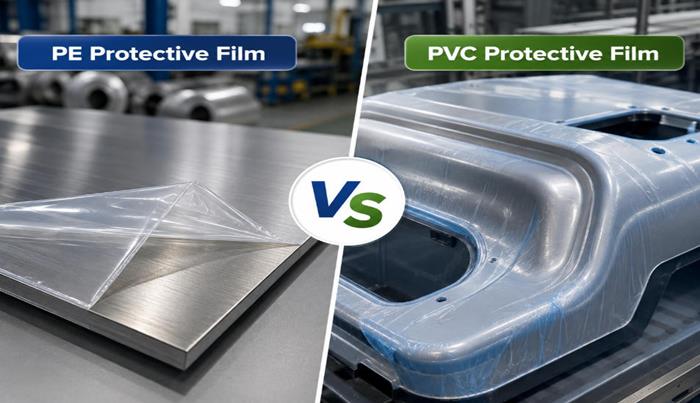
The main difference between PE protective film and PVC protective film is how each backing behaves during stretching, forming and exposure to industrial processing conditions.
PE, or polyethylene, is a lightweight thermoplastic commonly used for temporary surface protection. It can be combined with different pressure-sensitive adhesives to suit metal, plastic, glass and coated surfaces.
PVC, or polyvinyl chloride, is generally softer and more elastic. It can conform more easily to curved or deeply formed parts, although formulation and plasticizer selection can influence aging and removal behavior.
Both can function as plastic protective film, but they are not interchangeable in every process.
| Factor | PE Protective Film | PVC Protective Film |
| General-purpose protection | Excellent | Good |
| Flexibility | Good | Very good |
| Deep forming | Moderate-good | Very good |
| Complex surfaces | Good | Excellent |
| Weight | Lower | Generally higher |
| Chemical resistance | Application-dependent | Often stronger |
| Clean removal | Good with correct adhesive | Requires suitable formulation |
The table is only a starting point. Adhesive system, substrate and actual processing conditions can change the result significantly.
PE protective film is generally the better starting point when the application requires economical, lightweight and removable protection for flat or moderately formed surfaces.
It is commonly used on stainless steel, aluminum, painted panels, plastic sheets, glass and appliance components. The film can protect surfaces during slitting, cutting, assembly, storage and transportation.
A major advantage of PE protective film is its versatility. Adhesion can be adjusted for polished, brushed, coated or lightly textured surfaces without changing the basic backing material.
PE is especially practical when:
The substrate is flat or only moderately formed.
Large surface areas need economical temporary protection.
Clean removal is more important than extreme stretchability.
The film is used mainly during handling, cutting, storage or transport.
Its limitation appears when the substrate undergoes severe deep drawing or complex three-dimensional deformation. In those cases, the film may lift, stretch unevenly or tear if the backing is not flexible enough.
PVC protective film is more suitable when the protected part requires greater elasticity, conformability or resistance to demanding forming conditions.
Because PVC can be formulated with high flexibility, it can follow curves, embossed surfaces and deeper formed shapes more easily than many standard PE films. It may therefore suit appliance panels, decorative components and parts that undergo substantial deformation during production.
A properly specified PVC protective film can also perform well where processing oils or industrial fluids are present.
PVC may be preferred when the product experiences:
deep drawing, multiple bends, complex contours, substantial stretching or repeated contact with lubricants during forming.
However, higher flexibility does not automatically mean better overall performance. PVC formulations can include additives and plasticizers that influence adhesive interaction, aging and long-term removal. If the film remains on the substrate for weeks or months, or is exposed to elevated temperatures, compatibility testing becomes especially important.
For this reason, PVC protective film should be selected from actual process conditions rather than simply because the part is difficult to form.
PE protective film and PVC protective film should be compared under real production conditions because performance after forming or storage can differ from initial lamination performance.
A film that looks perfect immediately after application may later develop edge lift, wrinkles or excessive peel force. Buyers should focus on four practical factors:
Adhesion: The film should stay attached without becoming difficult to remove.
Formability: It should stretch sufficiently during bending, profiling or deep drawing.
Temperature and chemical resistance: Heat, oils and production fluids should not cause premature failure.
Removal performance: The film should peel cleanly after the required protection period.
These factors are usually more useful than comparing film thickness alone. A thinner film with suitable elongation may outperform a thicker but rigid film during forming.
It is also important to evaluate the adhesive and backing as one system. PE with the right adhesive may outperform PVC in a flat-sheet application, while PVC may be more reliable when the part undergoes severe deformation.
The right surface protection material should match the substrate, manufacturing process, protection period and final removal conditions.
Before choosing between PE and PVC, buyers should evaluate:
Substrate: stainless steel, aluminum, painted metal, plastic or glass.
Processing method: cutting, bending, profiling, stamping or deep drawing.
Protection period: short production protection or longer storage and transport.
Removal conditions: temperature, UV exposure and expected clean-peel requirements.
For flat sheets and moderate fabrication, PE protective film is often the more practical starting point. When a component needs greater elongation or must follow a complex shape, PVC protective film may offer better conformability.
A production trial is still essential. The film should ideally be tested through the same lamination, cutting, forming, storage and peeling conditions it will encounter in mass production.
Donlee works with different industrial surface-protection materials, so buyers can provide actual substrate samples and processing requirements rather than selecting only from general catalogue specifications. This makes plastic protective film selection more closely aligned with the real manufacturing process.
Choosing between PE protective film and PVC protective film depends on the balance between general-purpose protection and forming performance.
PE is usually the more economical and versatile option for sheets, panels and standard industrial applications. PVC is often more suitable when high elasticity, deeper forming or complex contours are required.
The best plastic protective film is therefore not defined by polymer type alone. Substrate finish, adhesive, forming severity, temperature, chemical exposure and dwell time should all be considered before bulk production.
Not always. PE is often better for general surface protection, while PVC can be more suitable for complex forming.
It is widely used for temporary protection of metal sheets, panels, plastics, glass and appliance surfaces.
PVC is useful when greater flexibility, deep drawing or complex surface conformability is required.
PVC often offers greater stretch, although suitable high-elongation PE films can also support moderate forming.
Yes. Excessive heat, long dwell time, incompatible adhesive or unsuitable substrate conditions can cause residue.
Test both film systems on the actual substrate under realistic production, storage and removal conditions before bulk ordering.