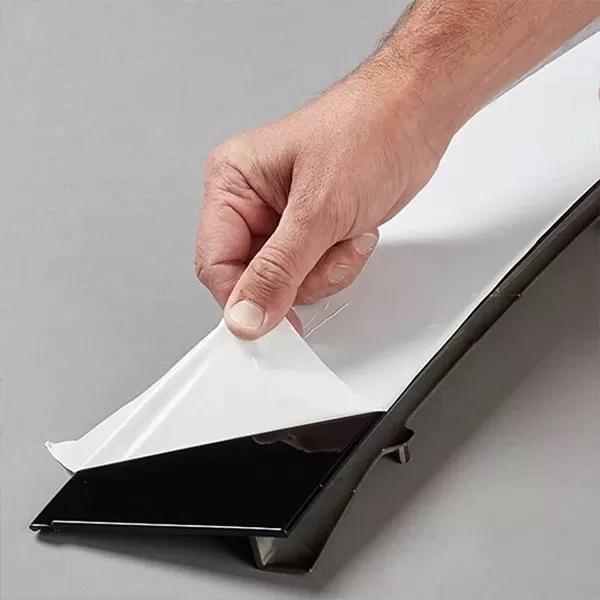
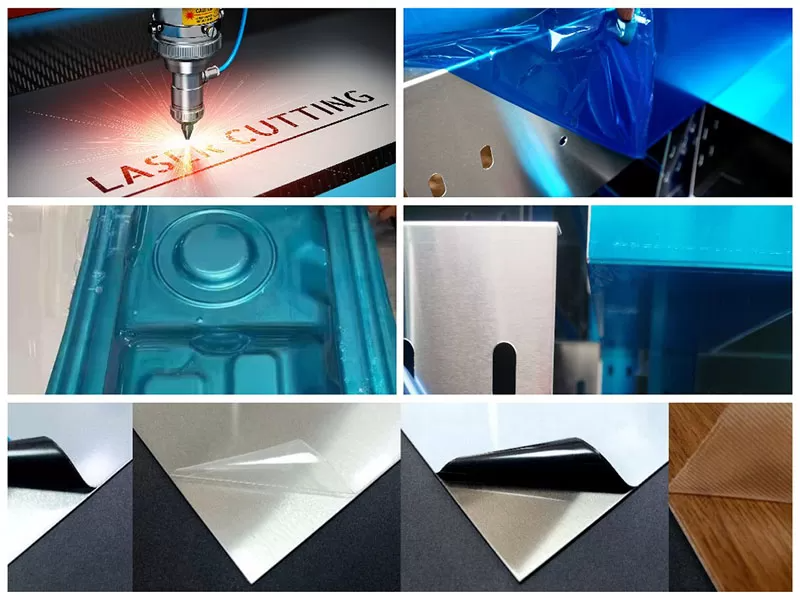
Protective film must stay attached through cutting, forming, handling, and transport, then remove cleanly without staining, ghosting, or adhesive residue. Selecting the highest peel adhesion is therefore not automatically safer. Excess adhesion can increase removal force or interact poorly with a delicate finish.
The correct adhesive level depends on surface texture, cleanliness, process stress, temperature, dwell time, and when the film will be removed. A sample tested on the customer's exact finish is more reliable than a generic ‘low’, ‘medium’, or ‘high’ label.
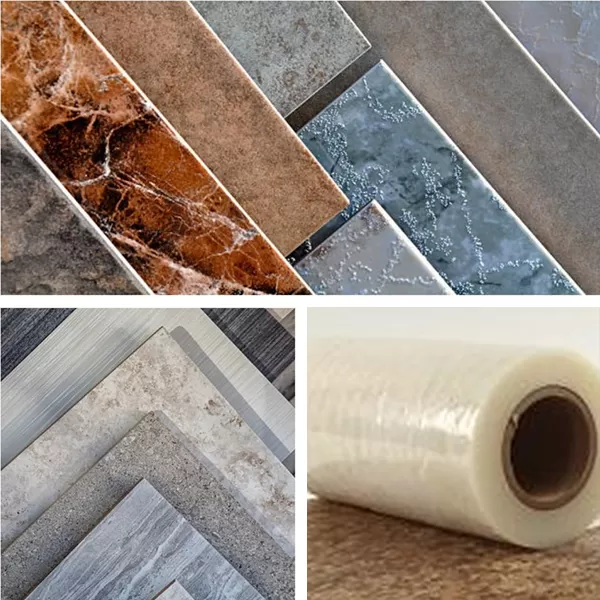
Mirror, brushed, hairline, matte, embossed, and coated stainless-steel finishes present different contact areas and visual risks. Rougher surfaces may need more conformability or adhesion to prevent edge lift, while mirror finishes can reveal even minor residue or optical marking.
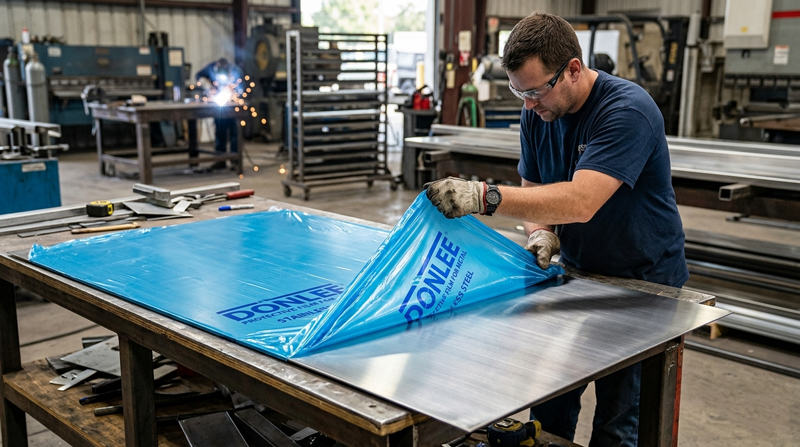
Donlee offers protective film for stainless steel across fabrication scenarios. The application should identify whether the substrate is coil, sheet, formed part, or finished component and whether laser cutting is involved.
Film lamination temperature and pressure
Slitting, stamping, bending, deep drawing, or roll forming
Laser cutting or other heat exposure
Stacking, palletizing, and transport vibration
Indoor or outdoor storage time
Final removal temperature and removal speed
Edge lift during forming suggests the film, adhesive, or lamination needs adjustment. Residue after long outdoor storage may point to excessive dwell, UV/heat exposure, or adhesive incompatibility. Diagnose the process stage before changing only the peel number.
A peel value is meaningful only with test angle, speed, dwell time, substrate, temperature, and units. Compare supplier data under equivalent conditions. The customer should also test after representative aging because adhesion can change over time.
Include both initial adhesion and removability after the longest expected process. Where laser cutting is involved, test cut-edge behavior, smoke/heat exposure, and film compatibility with the laser type and settings.
| Variable | Selection question |
|---|---|
| PE/PET/PP base | What elongation, stiffness, clarity, and temperature behavior are required? |
| Film thickness | Will the film resist puncture while conforming during forming? |
| Adhesive chemistry | Is it compatible with the finish, dwell, and temperature? |
| Color/print | Does the process need visibility, arrows, logo, or batch identification? |
| Release/removal | Can operators remove it safely at the final station? |
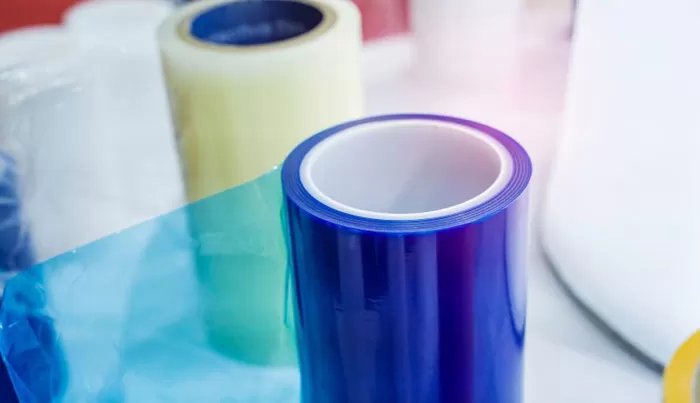
A stiffer film may bridge surface texture, while a highly extensible film may follow deep draws but be harder to remove in one piece if underspecified. Select the construction as a system.
Laminate samples on production-clean surfaces, not laboratory-perfect coupons only. Process them through the most demanding bend, draw, cut, stack, and aging conditions. Record edge lift, wrinkles, tearing, surface change, and removal force.
Approve the exact product code, lot, width, thickness, adhesive, and print. For mass supply, define change notification and incoming checks so production performance does not drift unnoticed.
There is no universal value. The best range depends on surface finish, process, dwell, temperature, and removal requirements, verified with a representative trial.
Possible causes include incompatible adhesive, excessive heat/UV exposure, long dwell, contamination, over-lamination, or removal outside the recommended conditions.
Sometimes, but the finishes have different contact and visual requirements. Test each finish separately before approval.
Provide finish, process steps, forming severity, laser details, lamination/removal conditions, storage duration, environment, dimensions, and annual volume.
Donlee can recommend sample constructions when the surface finish and process route are known. Use a documented production trial to approve adhesion, removability, and surface quality before scaling the order.